How to hire smarty software developers

By Oleksandr Shchetynin · CVO & CO-FOUNDER
- Published
- 4 min read
Our objective is to find a so-called 10x engineer. And, of course, without compromises on the quality of deliverables.
Key takeaways
- CML Team hires smarty software developers in five steps: resume and profile vetting, a screening call, an initial interview (mostly for Juniors), a technical interview and a test assignment.
- In the CML Team hiring funnel, only 1 out of 26 candidates selected during the resume vetting stage passes through the entire process.
- The CML Team screening call is run by recruiters, lasts 10-20 minutes and checks English, fit with corporate values and preliminary technical questions; the test assignment usually takes 4-8 hours.
- At CML Team the initial interview is mostly for Junior positions and can be skipped for Mid and Senior positions, and the technical interview is run by one or two middle-level engineers.
- Candidates are advised to prepare for behavioral questions, show how they solve problems and bring thoughtful questions of their own to the interviewer.
It's been a while since I wrote the previous article, "How We Hire a Rockstar Developer," and many of you probably wondered what the next steps would be after the initial interview. As the hiring process has evolved, our focus remains on finding exceptional software and smarty developers to drive success in complex projects. This article will guide you through our updated hiring process, optimized for efficiency and quality when looking for top-notch developers.
In short, we hire smarty software developers in five steps: vetting resumes and profiles, a screening call, an initial interview (mostly for Junior positions), a technical interview and a test assignment. Only 1 out of 26 candidates selected during the resume vetting stage passes through the entire process.
Over the past few years, our company has grown significantly, and the hiring process has changed accordingly. However, the core approach and principles remain the same.
We still aim to find 10x engineers who can work at a magnitude faster than average engineers without compromising the quality of deliverables. In the competitive hiring market, it's essential to streamline the process while ensuring the right candidate is chosen.

In this article, we will discuss our current hiring process for software and smarty developers, emphasizing efficiency and quality, and share some interesting experiences we've had in our hiring journey.
The Updated Hiring Process for Smarty Developers
Our current hiring process consists of the following steps:
- Vetting resumes and profiles on job sites and LinkedIn.
- Screening call performed by our recruiters to ensure the candidate possesses verbal and written English skills, fits our corporate values, and can answer pre-initial technical questions: “brick problem”, algorithmic complexity knowledge, etc. These calls last 10-20 minutes and help us narrow down candidates for the next stages.

- Initial interview is mostly for Junior positions and can be skipped for Mid/Senior positions. More details can be found in our previous article.
- Technical interview conducted by one or two middle-level software engineers, this interview focuses on technical questions related to the specific technology and assessing the candidate's logical and algorithmic thinking.
- Test assignment - usually takes 4-8 hours to complete and tests the candidate's skills in a real-world scenario.
In some cases, the client may want to conduct their own interview. However, our process remains relevant and mandatory to ensure only strong candidates are presented to the client.
Hiring Funnel Insights
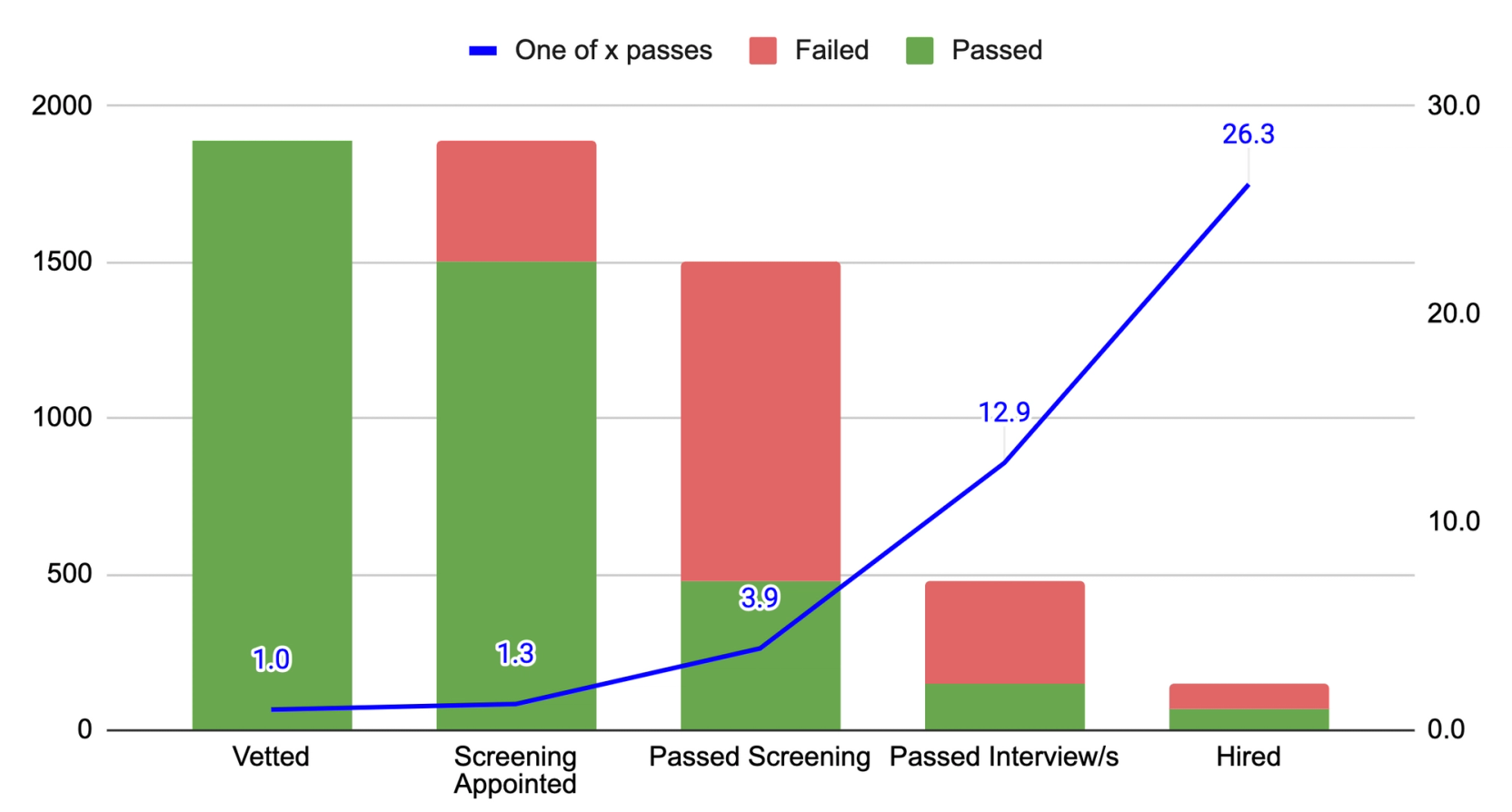
As shown in the hiring funnel below, only 1 out of 26 candidates selected during the resume vetting stage passes through the entire process. This approach allows us to deliver complex and challenging projects to our clients while maintaining top-notch quality and the ability to scale swiftly.
Tips for Candidates
There are numerous articles that aim to help software developers prepare for interviews. We would like to shed light on a few key points that often undeservedly remain in the shadows:
- Prepare for behavioral questions, you'll likely be asked about your experience working in teams, handling conflicts, and mentoring junior developers. Reflect on these experiences and prepare concise, specific examples to share with the interviewer.
- Showcase your problem-solving skills, good developers are often tasked with solving complex problems. Practice solving coding challenges and discussing your thought process out loud to demonstrate your ability to think critically and systematically.
- Ask insightful questions: Prepare a list of thoughtful questions to ask the interviewer about the company, team, and role. This shows your enthusiasm and interest in the position and helps you assess if the opportunity is a good fit for you.
Challenges and trends
Hiring process became much more challenging, and competition grew dramatically. We can’t afford any longer to keep candidates in the loop for weeks. At the same time we don’t want to hire the wrong person, and don’t want to waste pointlessly precious time of our software engineers. Another issue that has emerged since 2020 is the significant increase in the number of developers wanting to work remotely. Our process addresses these issues by:
- Continuously updating our requirements and expectations to match the evolving skill sets needed in the industry.
- Adapting our interview process to accommodate remote work, utilizing video calls and online assessments to effectively evaluate candidates from a distance.
- Staying informed about industry trends and emerging technologies to ensure our candidates are well-versed in the latest tools and practices.
Our updated hiring process is designed to efficiently and effectively identify and hire software developers who can drive success in complex projects.
If you need reliable and high-performance developers, don't hesitate to contact us. We not only provide the best candidates but also manage them, ensuring the success of your projects. Stay tuned for our upcoming articles, where we'll dive even deeper into the hiring process and share more insights and experiences.
Next step
About the author

CVO & CO-FOUNDER
Worked in companies of different sizes, from successful startups to Fortune 500 companies, performing mission-critical responsibilities, developing and implementing high-tech IT solutions for a variety of industries.
More from Oleksandr ShchetyninCategory:ProcessesWorking with engineers
Back to Blog